Tuesday, February 28, 2006

Sharp First with VGA Display


Vodafone today anounced the 904SH by Sharp, the world's first mobile phone will a full VGA-resolution display, offering 480 x 640 pixels. First previewed at 3GSM earlier this month, it was announced today that the 904SH also features a 3.2 megapixel autofocus camera with 2x optical zoom and facial recognition biometric security. Other features of the phone include 3D motion sensor, FeliCa e-money capability, Bluetooth, GPS, and miniSD memory card slot. The 904SH is a WCDMA/GSM phone that will be available in Japan starting in late April.

Sony Ericsson Unveils 2006 Lineup


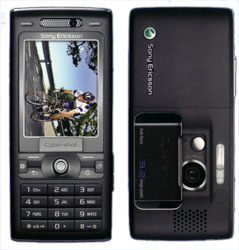
K800: Bar-style 3G camera phone with Cybershot 3.2 megapixel autofocus camera, true xenon flash, QVGA display, music player, FM radio, Bluetooth 2.0, full HTML browser with RSS, USB 2.0 with mass storage mode, Blogger integration, Memory Stick Micro (M2) card slot, and push email support (P-IMAP).
K790: Same as K800 except tri-band EDGE (including Americas version with GSM 850) instead of 3G.
W300: Clamshell quad-band GSM phone with Walkman music player, EDGE data (class 10), Memory Stick Micro (M2) card slot (256 MB card included,) FM radio, VGA camera, Bluetooth, USB 2.0 with mass storage mode, monochrome outer display, and Adobe Flash technology.
K510: Bar-style tri-band GSM phone with 1.3 megapixel camera and Bluetooth. Also features a full HTML browser with RSS reader, changeable covers, and speakerphone. Available in versions for Europe/Asia and the Americas (with GSM 850).
Z530: Clamshell tri-band phone with Bluetooth and Memory Stick Micro (M2) card slot. Also features a VGA camera, music player, USB 2.0 with mass storage mode, and changeable covers. No GSM 850 version.
K310: Basic bar-style tri-band phone with VGA camera, push email, speakerphone, and changeable covers. Americas version will have GSM 850.
All of the phones announced today are expected to start shipping in the 2nd quarter of this year.

Sony Ericsson puts Cybershot brand on photo phones

PARIS (Reuters) - Sony Ericsson unveiled six new mobile phones on Tuesday and said that two of them have cameras good enough to carry Sony's Cyber-shot digital camera brand.

It is the second brand transfer by Japanese consumer electronics parent Sony (6758.T) to its mobile phone joint venture with Sweden's Ericsson (ERICb.ST). A year ago Sony Ericsson, the world's number five handset maker, adopted the Walkman brand for its music phones.

"These phones deliver the same digital still camera experience as Cyber-shot. It is only now that we felt we could adopt the reputable Cyber-shot brand," said the venture's head of global product marketing, Steve Walker.

Sony was the world's second-biggest producer of digital cameras in 2004, according to market research IDC, and it uses the Cyber-shot brand to market its products.

The K800 and K790 mobile phones feature a 3.2 megapixel autofocus camera, an image stabilizer, a flash which is brighter than usual for mobile phones and a sensor that can snap nine full resolution images within a second. The technology, including software to improve picture quality, comes from Sony.

"There was extremely good cooperation," Walker said.

Two variants -- a model for 3G mobile networks and one for older 2G networks -- will be available in the second quarter at prices above 300 euros ($355.4) each before operator subsidies.

Four cheaper camera and Walkman phones were also unveiled on Tuesday including a camera phone for less than 100 euros and a Walkman phone priced between 100 and 200 euros, the cheapest Walkman model yet.

The joint venture plans to start selling the six new models in the second quarter. They will bring its new phone introductions so far this year to 11, compared with 30 new models last year.

"We'll have more product launches in 2006 compared with 2005," Walker said.

Cable & Wireless aims to cut up to half its staff in five years

LONDON (AP) - Cable & Wireless Group PLC, Britain's second-largest telecommunications company, said Tuesday it aims to shed up to half of its workforce, or up to 3,000 jobs, within five years.

The company said it envisages cutting staff from the current 5,500 to between 2,500 and 3,500 as it concentrates on fewer and larger corporate customers while reducing the complexity in its products and systems.

C&W said this will allow the business to reduce costs and set higher standards for customer service.

The company said it plans to reduce its customer base from about 30,000 customers to about 3,000 large corporate customers and public institutions.

John Pluthero, executive director of Cable & Wireless, said 89 per cent of the company's customers generate four per cent of revenue and around two per cent of its gross margins.

He also said he is confident the company can reach its revenue goal of two billion pounds ($3.5 billion).

C&W has undergone significant restructuring over the past two years after pulling back from a nine-billion-pound ($16.4-billion-US) plan to become a global carrier for large businesses.

Last year, the company acquired Energis, a British fixed-line telecommunications company. C&W said it expects the merger to yield cost savings of more than 40 million pounds ($69.7 million) a year by the end of March 2006.

C&W shares were off 1.2 per cent to 107.25 pence ($1.87) on the London Stock Exchange.

Cable & Wireless aims to cut up to half its staff in five years

LONDON (AP) - Cable & Wireless Group PLC, Britain's second-largest telecommunications company, said Tuesday it aims to shed up to half of its workforce, or up to 3,000 jobs, within five years.

The company said it envisages cutting staff from the current 5,500 to between 2,500 and 3,500 as it concentrates on fewer and larger corporate customers while reducing the complexity in its products and systems.

C&W said this will allow the business to reduce costs and set higher standards for customer service.

The company said it plans to reduce its customer base from about 30,000 customers to about 3,000 large corporate customers and public institutions.

John Pluthero, executive director of Cable & Wireless, said 89 per cent of the company's customers generate four per cent of revenue and around two per cent of its gross margins.

He also said he is confident the company can reach its revenue goal of two billion pounds ($3.5 billion).

C&W has undergone significant restructuring over the past two years after pulling back from a nine-billion-pound ($16.4-billion-US) plan to become a global carrier for large businesses.

Last year, the company acquired Energis, a British fixed-line telecommunications company. C&W said it expects the merger to yield cost savings of more than 40 million pounds ($69.7 million) a year by the end of March 2006.

C&W shares were off 1.2 per cent to 107.25 pence ($1.87) on the London Stock Exchange.

Mobile phone sales hit 817 million in 2005


PARIS (AFP) - Worldwide sales of mobile telephones rose by 21.0 percent last year when a total of 816.6 million handsets were taken up by users, and slightly more than half of them were made by Nokia and Motorola, a study by Gartner research showed.

Overall sales were driven by continuing demand in emerging markets, and by consumers in Western Europe and North America who snapped up new models to replace their existing mobiles.

Stiff competition among major players drove down prices for basic handsets and increased pressure to add applications and change design, it said.

Six companies shared 79.4 percent of the market last year, according to the study: Nokia, Motorola, LG, Samsung, Sony Ericsson and Siemens.

Nokia and Motorola increased their share to 50.2 percent, compared with 46.1 percent in 2004.

Nokia of Finland sold a total of 265.61 million mobile telephones representing 32.5 percent of the market from 30.7 percent in 2004.

The company sold twice as many telephones as its competitors in Western Europe and Asia, and three times more in the Eastern Europe, Middle East and African regions.

The share of the global market held by Motorola of the United States rose to 17.7 percent from 15.4 percent in 2004. It sold 144.92 million handsets and held on to its number two position worldwide and in Western Europe, and its top slot on its home market.

Samsung of South Korea stayed in third place, selling 103.75 million telephones and increasing its market share only slightly to 12.7 percent from 12.6 percent in 2004.

Gartner put that down to a decision by the company not to engage in a price war with its competitors or to step into emerging markets.

LG, also of South Korea, sold 54.9 million telephones, representing a market share of 6.7 percent. In 2004 it had a 6.3-percent slice.

The Swedish-Japanese alliance Sony Ericcson, which was in fifth place, sold 51.77 million. That represented 6.3 percent of the market, up from 6.2 percent in 2004.

Germany's Siemens, however, saw a slump. Its 2005 sales of 28.59 million were almost half those a year earlier.

Overall, the industry sold 164.0 million mobiles in Western Europe last year.

The East European, Middle East and African market was almost as healthy, reaching a combined 153.5 million.

In North America, sales were 148.4 million, while in Latin America they hit 102 million, a 40.0-percent increase from the figure in 2004. In the Asia-Pacific region, sales reached 204.0 million.

Sony Ericsson to use Google search and Blogger

LONDON (Reuters) - Sony Ericsson said on Tuesday it was linking up with Google Inc. to incorporate the company's Web search and blog features into its mobile phones.

Phones will be able to launch a separate Google Web search option using a single keystroke without the need to open a new Web page.

"By providing users with direct access to features like mobile search and blogging, we're able to create a more personalized, user-friendly experience," said Google's European operations, vice president, Nikesh Arora.

Users will also be able to post blogs through a pre-loaded application linked to the Google-owned Blogger site.

A blog, short for Web log, is an online journal people use to express opinions, post pictures and share experiences.

Sony Ericsson said the new services would be launched in the second quarter of the year and be available on the K610 UMTS phone and the newly launched K800 and K790.

Monday, February 27, 2006

NTP vs. RIM hearing coverage, no injunction today

In this morning's remand hearing, NTP asked the court for $126 million in damages, in addition to undetermined royalties, and an immediate injunction of services in the US. "The world, we suggest, will not come to an end," said James Wallace, attorney.

NTP has also outlined its suggestions to U.S. District Judge James Spencer for how an injunction might be implemented: 30 days to give RIM time to work with its customers to enable a work around and exemptions to Federal, State, and Local Governments, including "first responders".

RIM responded with a request for a new trial, because of claims that were thrown out by a Federal court. Insiders also believe that a new trial would benefit RIM because the US Patent and Trademark Office has moved to reject all of the infringed upon patents.

There are about 3.2 million Blackberry users in the U.S. who could be affected by an enforced injunction. RIM’s (RIMM) stock is getting lift, especially after the second patent rejection.

Coming in late, it appears that the US Patent and Trademark office has offered a final rejection for a second NTP patent.

The judge did not decide on the case today, a ruling is expected next week. He did however urge the two companies to settle, hinting at a possible injunction grant soon. “In plain words, the case should have been settled, but it hasn’t so I have to deal with that reality.”

Nokia makes US top priority

Nokia is the worldwide top mobile phone maker, but its sales lag in the US market. The company's incoming CEO, Olli-Pekka Kallasvuo, is making the US his top priority. Kallasvuo will become CEO on June 1st when Jorma Ollila steps down. Red Herring reports on the story:

“In mobile phone operations, we aim for leadership in everything,” he said. “If you aren't the leader in each sector and segment, you will easily lose out. You cannot be strong in one area and just take part in another.”
The handset market share leader in the US is Motorola, thanks mostly to the RAZR and their other clamshell handsets. Nokia was slow to embrace the clamshell form factor despite its huge popularity. Also differentiating the US market from the rest of the world is the role of wireless carriers. To have a successful handset in the US a carrier distribution deal is necessary.

Just last week Nokia announced a partnership with Sanyo to create CDMA handsets. Other acquisitions and partnerships may be on the way, according to Mr. Kallasvuo.

SanDisk announces 4GB Memory Stick DUO Pro

SanDisk announced a 4GB Memory Stick DUO Pro at PMA on Sunday. The new chip doubles the previous best of 2GB. While it's being marketed to megabyte hungry digital photographers, it will also work fine in a Sony Ericsson Walkman branded phone. This will allow a current W800i or W900i to compete head-to-head with the Nokia N91 or iPod nano in storage capacity. No other cell phone maker uses the Memory Stick DUO format.

Sony Ericsson announced a music phone earlier this month that sports 4GB of internal flash memory, the W950i. It doesn't have a memory card slot for expandable storage.

SanDisk will begin shipping the 4GB card next month for an estimated $239.99.

CBS to launch wireless alerts service

NEW YORK (Reuters) - Television and radio station owner CBS Corp. on Monday said it plans to launch a service that offers wireless breaking news video and text alerts, as it seeks to find new places for its programing.

CBS will offer two wireless services called "CBS News TO GO" and "ET TO GO" beginning next week for a monthly fee of 99 cents and $3.99 respectively.

Subscribers will get up to five alerts sent to their cell phones daily that include text, video and pictures

Friday, February 24, 2006

Calif. bill would bar toxins in cell phones, iPods


SAN FRANCISCO (Reuters) - California would require manufacturers to phase out the use of hazardous materials in making cell phones, iPods and other electronic devices under a bill introduced by a state lawmaker.

The bill unveiled on Thursday by Assembly Member Lori Saldana, a Democrat from San Diego, would apply to any electronic or battery-operated device. The bill, which was introduced on Wednesday, would require manufacturers to stop using the substances in devices sold in California by 2008.

"We know that the manufacturers of these products are able to produce them without including harmful toxic materials," Saldana said in a written statement. "California deserves to be included among the markets that receive this cleaner stream of consumer electronics."

California already requires manufacturers of video displays in devices to phase out the use of toxic materials.

Environmental groups with clout in the state's Democrat-led legislature support the bill.

They are concerned about pollution from electronic devices discarded in landfills and want California to follow the example of the European Union, which has called for phasing out the use of toxic materials in making consumer electronics.

"Cell phones, iPods, computers and many other modern electronic devices have a useful life of maybe a year or two before they become obsolete," said Mark Murray, executive director of the group Californians Against Waste. "It doesn't make sense to use hazardous materials in these disposable devices."

About 70 percent of toxic heavy metals found in landfills come from electronic products, which may contain lead, cadmium, chromium and mercury, according to Californians Against Waste.

"This brew of toxic substances can damage nervous, kidney and reproductive systems, while some of the metals contain carcinogens," according a statement released by the group.

Apple Computer Inc. (Nasdaq:AAPL - news) last year started a program at its retail stores to encourage consumers to recycle their iPod music- and video-playing devices in exchange for a discount on new devices.

Tech CEOs Urge U.S. Find More Wireless Airwaves

WASHINGTON (Reuters) - Chief executive officers of some leading technology companies plan to call on Thursday for the U.S. government to find more wireless airwaves for use as new applications emerge.

The Technology CEO Council said on Wednesday it will issue a report urging Congress to order the Bush administration to analyze which airwaves are not being used best, and how they might be re-allocated.

Additionally, the organization plans to urge the Federal Communications Commission and the National Telecommunications and Information Administration to consider allowing government airwaves that are underutilized to be used for other purposes.

"Our nation's wireless needs are too often governed by 1970s regulations that hinder economic progress and innovation," Motorola Inc. CEO Edward Zander said in a statement obtained by Reuters. He serves as chairman of the technology organization.

The group pushing for the changes also includes executives from Hewlett-Packard Co. , IBM , Intel Corp. , Dell Inc. , EMC Corp. and Unisys Corp. , among others.

Wireless companies have been hungry for more airwaves as they deploy new services like high-speed Internet and video content.

The executives also plan to suggest the FCC ease restrictions on wireless licenses so companies have more flexibility to use the airwaves for new services. They also will recommend making more unlicensed spectrum available that could be used for a variety of purposes.

The organization also plans to recommend Congress and regulators ensure that public safety organizations have the airwaves they need. Safety officials have complained about poor communications during disasters like the September 11 attacks and Hurricane Katrina.

The FCC is slated to start auctioning some airwaves June 29, including some airwaves that government agencies are vacating.

Other airwaves are expected to be sold in 2008 ahead of the 2009 move by U.S. television broadcasters from analog wireless airwaves to other airwaves for their digital television signals.

Can Your Cell Phone Help With the Laundry?

IBM has collaborated with two universities to develop several speech-enabled Web applications for mobile phones, the company said Friday.


The U.S. company is partnering with Wake Forest University in Winston-Salem, North Carolina, and the University of California, Santa Barbara (USCB) to test technologies that it may eventually offer to other types of users, such as sales forces, physicians, and emergency response teams, according to the company.


The MobileU program allows students to ask "What time is the next bus coming?" into their cell phones. Global Positioning Satellite devices inside the buses use GPRS (General Packet Radio Service) to transmit their location to servers on campus and ultimately to students' mobile phones to tell them how long they have to wait.


The application, developed with Wake Forest University, uses IBM WebSphere Everyplace Multimodal Environment software.


With LaundryView, IBM built an application on top of an existing Web application developed by the Mac-Gray, which provides laundry management services to schools.


Students at Wake Forest living in special, tech-enabled facilities can ask any Internet-connected device how many washers and dryers are currently in use. As a result, they don't have to waste time walking to the laundry room to find out whether any machines are free.

Park and Pay

Park and Pay-by-Cellphone, an application developed by IBM and USCB, is one of North America's first wireless parking systems that integrates a payment system, according to IBM.


Drivers call a phone number, enter the stall number, and park. They can purchase additional parking time remotely by making another phone call. Parking fees are charged to their credit card. The new system tracks enforcement through a wireless network connecting 50 payment stations.


With the Personal Information Manager application, USCB students can ask their mobile phones what their e-mail inbox contains. It will also inform them audibly about their calendar entries and read them instant messages and newspaper articles as they walk to class or drive their cars.


The application takes RSS (Really Simple Syndication) feeds from university and national newspapers and enters them into a speech-enabled Web browser. News is fed over standard Web protocols and dynamically formatted for speech input and output.


The applications are hosted on IBM WebSphere application server and synchronized to the devices using IBM Workplace Client Technology Micro Edition, a miniature application server that allows Web applications to continue to function when wireless access is not available.

NTP wants US$126 million in damages for claim against RIM's BlackBerry

RICHMOND, Va. (AP) - Patent-holding company NTP Inc. asked a U.S. judge Friday to award it $126 million in damages and issue an injunction against the maker of the popular BlackBerry wireless e-mail service for violating its patents.

The damages would be in addition to royalties NTP is seeking from Canadian company Research In Motion Ltd. (TSX:RIM - news), maker of the BlackBerry.

NTP completed its presentation before U.S. District Judge James Spencer and was to be followed by lawyers for RIM.

It was not clear whether Spencer would rule Friday.

Ericsson files vs Samsung, alleges patent violation

STOCKHOLM (Reuters) - Mobile network equipment giant Ericsson (ERICb.ST) has filed suit against mobile phone maker Samsung Electronics Co. Ltd (005930.KS) alleging patent infringement, Ericsson said on Friday.


"We have filed a lawsuit against Samsung for patent infringement in the U.S., UK, Germany and the Netherlands," said Ericsson spokeswoman Ase Lindskog.

"The reason is that we have had extensive negotiations with Samsung over a renewal of licences because their agreement with us expired on December 31 last year," she added. "They are using mobile phone patents which no longer have licences."

A spokeswoman for Samsung in Seoul declined to comment.

Patent infringement and other legal battles can be quite common in the tech sector, where companies spend heavily on research and development.

Ericsson was among companies which last year complained to the European Union about Qualcomm Inc. (Nasdaq:QCOM - news), which they said was stifling competition in the mobile phone chip market. Qualcomm later filed a GSM patent suit against Nokia Oyj

(NOK1V.HE).

Lindskog said the technologies over which Ericsson had filed suit against Samsung were GSM, GPRS and EDGE.

"This is an unfortunate action but we must protect our shareholders and investors as we have invested large amounts in research and development over the years," she said.

Thursday, February 23, 2006

16% of US own two mobile phones

USA Today is reporting on a new survey that found 16% of American wireless customers have two mobile phones (one for business and another for personal use). Five years ago the figure was nearly zero. The study was performed by a research group named Compete and also found a couple other interesting data points:

70% of Fortune 100 companies supply and pay for mobile phones
Of those companies, 25% bar personal calls
One of the major reasons for using two phones was to separate business and personal matters--after work hours the business phone can be turned off.

New cell Phone Release: Sony Ericsson K800i

Sony Ericsson K800i

Rumors of the Sony Ericsson K800i have been circulating for a while, but new photos and a complete specs list were leaked onto a forum yesterday. The handset will be the next gen ahead of the popular K750i and may include a version with UMTS.

Features of the K800i are rumored to include:

3.2-megapixel camera with autofocus
QVGA screen with 262K colors
64MB internal memory, plus Memory Stick Micro slot
USB 2.0
Bluetooth

Cingular Partners For International MMS

Aicent today revealed that it will immediately begin work with Cingular to expand MMS interoperability beyond American shores. Cingular currently is one of the top US carriers in terms of national interoperability; this agreement will put them at the forefront of international interop as well. Aicent provides MMS interop to 70 operators around the world, and is adding more with agreements similar to Cingular's. In addition to MMS, Cingular partners with Aicent for international GPRS roaming


The Federal Judge presiding over the NTP vs. RIM patent dispute today took another step to guarantee the trial will start this Friday as scheduled. Judge Spencer turned down a request by the Federal Justice Department to hold a separate hearing to explore how a Blackberry shutdown could affect government agencies and offices. The hearing would have further delayed the trial, which the judge has noted he will not allow. The Justice Dept. has previously filed two briefs with the court concerning the effects of a shutdown on government and public safety agencies. It is likely those papers provided the judge with all the information he needs regarding the federal government's position and concerns.

The FCC today approved a set of accessories for Motorola that reveals plans to launch a set of remote controlled cars in cooperation with Nikko. Chances are Motorola will use this opportunity to further tie in Nextel's NASCAR sponsorship to iDen handsets. The approval was for a Zigbee dongle that can either plug into a traditional looking RC vehicle remote or into the accessory port of an iDen phone. Either the dual-joystick remote or a Java application on an iDen handset (specifically an i850), can then be used to control a Zigbee-enabled RC car. Each "Wireless Wheels" set will include a dongle, remote and car. This is not the first phone-controlled RC car. A few years ago, Sony Ericsson sold a Bluetooth car that could be controlled from any of their Bluetooth-enabled phones.

Sprint Nextel today announced a new pricing plan called Business Essentials. The plan allows companies to buy large buckets of minutes and distribute them to employees using whatever calling plan suits each particular person. It also provides free mobile to mobile calls for employees on Sprint or nationwide walkie talkie to those on Nextel. Sprint users can add Ready Link PTT and Nextel subscribers can add mobile to mobile for an additional $5 per month. Cingular yesterday launched OfficeReach, an application that allows businesses to assign each employee a single phone number and internal phone extension which will contact that employee at up to three separate telephones. The system will attempt to reach the employee at each number in a pre-defined order when the unified OfficeReach number is called. Similar services have been available in corporate PBX systems before, however OfficeReach does not require PBX equipment.

Sprint Nextel profit falls, wireless disappoints

NEW YORK (Reuters) - Sprint Nextel Corp. (NYSE:S - news), the No. 3 U.S. mobile phone service, posted a 55 percent drop in quarterly net earnings on Wednesday, hurt by merger expenses and disappointing wireless growth, sending its shares down.

Some investors were disappointed that the company reported lower-than-expected growth in high-value wireless customers who pay their bills monthly.

Sprint is spinning off its declining local phone business later this year in order to focus on its higher-growth wireless business. But some investors are concerned that wireless growth is slowing as most U.S. consumers already have cell phones.

"Sprint Nextel is having to go after a lesser quality subscriber," said Stifel Nicolaus analyst Chris King, referring to wireless customers who pay for calls in advance rather than receive a monthly bill.

Growth in prepay customers was strong in the fourth quarter, but Nicolaus said he expected 900,000 new bill-paying customers, compared with Sprint's report of 746,000.

Shares of Sprint, which acquired Nextel Communications last August, were down 75 cents, or 3 percent, at $24.18 in afternoon trade on the New York Stock Exchange. They fell as low as $24.06 earlier in the session.

Rivals like Cingular Wireless, the No. 1 U.S. service, also derive a lot of their growth from less valuable customers who pay for calls in advance and buy discounted postpaid family plans. Because its Nextel brand does not offer family plans, Sprint missed out on some growth in the fourth quarter.

Sprint Chief Financial Officer Paul Saleh said the company would change its Nextel pricing plans in order to improve its chances of winning customers looking for group discounts. But he said Sprint is holding its own in the market.

"We're maintaining our share in the marketplace so I'm not sure what people are disappointed at," he told reporters in a telephone conference.

The Nextel brand depends mainly on the popularity of a walkie-talkie style service among business clients. Sprint runs separate networks and service plans for Sprint and Nextel customers.

As some analysts had expected, Sprint said it would offer a nominal recurring dividend after it spins off its local business next quarter. It also said its board may consider buying back some of its shares. It did not give details.

Sprint also said that by year-end its work force of 60,000, excluding the local unit, would be about 4 percent smaller as it looks to reduce job duplication following the merger.

MERGER COSTS WEIGH

The company said fourth-quarter net profit fell to $197 million, or 7 cents a share, from $437 million, or 29 cents a share, a year earlier.

Before unusual items, such as a charge of 18 cents per share mostly for merger-related amortization, it earned 33 cents a share, a penny short of analysts' average forecast.

Revenue rose 7 percent to $11.3 billion, assuming Sprint owned Nextel in both quarters. This was slightly ahead of the average Wall Street estimate of $11.26 billion.

Sprint Nextel shares are down about 5 percent since the company was formed, reflecting investor concerns about slowing wireless industry subscription growth. This was its first full quarterly report as a merged company.

It said it expects 2006 consolidated revenue of $41 billion, assuming high-single-digit to low-double-digit growth in wireless and a mid- to high-single-digit revenue decline for its long-distance business.

King said the 2006 revenue forecast was in line with his estimates but appeared to disappoint some investors.

Sprint forecast 2006 adjusted operating income of about $13 billion before depreciation and amortization.

Wednesday, February 22, 2006

AT&T, Yahoo Link Web To Cingular Mobile Phones

NEW YORK (Reuters) - AT&T Inc. and Yahoo Inc. (Nasdaq:YHOO - news) are launching a service that lets people use Cingular mobile phones to get access to their photos, e-mail, instant messaging and address books on their Yahoo accounts, AT&T said on Tuesday.

The AT&T Yahoo Go Mobile service is part of the Yahoo Go brand, the Internet media company's push to make its services available to users on a variety of devices from mobile phones to televisions.

"It's the first kind of baby steps toward this whole concept of an anytime-anywhere device," said Matt Davis, director of consumer multiplay services at IDC, a market research firm in Framingham, Massachusetts.

The phone also includes an MP3 music player and a digital voice recorder.

Go Mobile, which will be available on the Nokia 6682 mobile phone, will be sold online, in AT&T's 13-state service area and at some Cingular Wireless stores in Austin, Texas; Columbus, Ohio; and Los Angeles.

Cingular, the nation's largest wireless company, is jointly owned by AT&T and BellSouth Corp. .

The phone costs $199.99 after a $50 mail-in rebate from Nokia with a two-year subscription to a Cingular wireless service plan. AT&T also recommends that customers subscribe to its wireless data service. The unlimited monthly service costs about $19.99 a month, an AT&T spokesman said.

Yahoo's Go Mobile Comes Calling

Yahoo made its Go Mobile cell-phone portal service available in the U.S. for the first time this week, working with AT&T and Cingular Wireless to offer Go Mobile on a Nokia handset.

Go Mobile was announced last month at the International Consumer Electronics Show (CES) in Las Vegas as part of Yahoo's Go service, which lets consumers access Yahoo content on a PC, TV, or mobile phone. The idea is to let people get to their e-mail, contacts, calendar, personal photos, and other content through a single portal available in different forms on those devices.


Yahoo is offering the Go Mobile software preloaded on Nokia 6682 handsets for the Cingular network that are sold by AT&T in its traditional 13-state service area. Phones with the service will also be sold by Cingular in select stores in Austin, Texas; Columbus, Ohio; and Glendale, California, according to AT&T spokesperson Sue McCain. AT&T, formerly SBC, is the majority owner of Cingular and a sales agent for the mobile operator. AT&T is selling the phones as a way to extend users' AT&T/Yahoo broadband experience to mobile phones, McCain says. Cingular's role in selling them will probably increase, she says.


The Nokia 6682, a GSM/GPRS (Global System for Mobile Communications/General Packet Radio Service) phone with a digital music player, a removable media slot, and a 1.3-megapixel camera, is already for sale to Cingular subscribers. Users with existing 6682s can download the Go Mobile software from Yahoo's Web site, says Nicole Leverich, a spokesperson for Yahoo, in Sunnyvale, California.

Subscription Not Required

Users don't have to be subscribers to AT&T and Yahoo's co-branded broadband service to use Go Mobile. They can sign on with either an AT&T/Yahoo broadband e-mail address or one for Internet-based Yahoo Mail, Leverich says. The phone can save the subscriber's password for easier use or require it on every login, depending on customer choice. There is no charge for the Go Mobile service, but using it will require a Cingular data plan.


In addition to e-mail, contacts, and calendar, users can look at their Yahoo personal photo collections on the phone and automatically upload the pictures they take with the phone to Yahoo, Leverich says. Go Mobile also offers news, weather, and sports customized for the individual user as well as Web, image and local search. Some Yahoo portal content that would be available via through a PC or TV, such as movie clips, will not be available via Go Mobile, she says.


Yahoo recently began preloading Go Mobile on several Nokia phones on sale at retail stores in Europe, Leverich says. At CES, Yahoo Chairman and Chief Executive Officer Terry Semel said the service would be available soon on the hot-selling Motorola Razr. The company ported the software first to the Symbian OS, used on Nokia phones, but is also working with Motorola on a Java version for its phones, Leverich says. Go Mobile will be available on the Razr by the end of this year, she says.


The 6682 is available through AT&T's sales channels for $199.99 with a two-year Cingular service plan, after a $50 mail-in rebate from Nokia.

Sprint Nextel profit falls, wireless disappoints

NEW YORK (Reuters) - Sprint Nextel Corp. (NYSE:S - news), the No. 3 U.S. mobile phone service, posted a 55 percent drop in quarterly net earnings on Wednesday, hurt by merger expenses and disappointing wireless growth, sending its shares down.

Some investors were disappointed that the company reported lower-than-expected growth in high-value wireless customers who pay their bills monthly.

Sprint is spinning off its declining local phone business later this year in order to focus on its higher-growth wireless business. But some investors are concerned that wireless growth is slowing as most U.S. consumers already have cell phones.

"Sprint Nextel is having to go after a lesser quality subscriber," said Stifel Nicolaus analyst Chris King, referring to wireless customers who pay for calls in advance rather than receive a monthly bill.

Growth in prepay customers was strong in the fourth quarter, but Nicolaus said he expected 900,000 new bill-paying customers, compared with Sprint's report of 746,000.

Shares of Sprint, which acquired Nextel Communications last August, were down 75 cents, or 3 percent, at $24.18 in afternoon trade on the New York Stock Exchange. They fell as low as $24.06 earlier in the session.

Rivals like Cingular Wireless, the No. 1 U.S. service, also derive a lot of their growth from less valuable customers who pay for calls in advance and buy discounted postpaid family plans. Because its Nextel brand does not offer family plans, Sprint missed out on some growth in the fourth quarter.

Sprint Chief Financial Officer Paul Saleh said the company would change its Nextel pricing plans in order to improve its chances of winning customers looking for group discounts. But he said Sprint is holding its own in the market.

"We're maintaining our share in the marketplace so I'm not sure what people are disappointed at," he told reporters in a telephone conference.

The Nextel brand depends mainly on the popularity of a walkie-talkie style service among business clients. Sprint runs separate networks and service plans for Sprint and Nextel customers.

As some analysts had expected, Sprint said it would offer a nominal recurring dividend after it spins off its local business next quarter. It also said its board may consider buying back some of its shares. It did not give details.

Sprint also said that by year-end its work force of 60,000, excluding the local unit, would be about 4 percent smaller as it looks to reduce job duplication following the merger.

MERGER COSTS WEIGH

The company said fourth-quarter net profit fell to $197 million, or 7 cents a share, from $437 million, or 29 cents a share, a year earlier.

Before unusual items, such as a charge of 18 cents per share mostly for merger-related amortization, it earned 33 cents a share, a penny short of analysts' average forecast.

Revenue rose 7 percent to $11.3 billion, assuming Sprint owned Nextel in both quarters. This was slightly ahead of the average Wall Street estimate of $11.26 billion.

Sprint Nextel shares are down about 5 percent since the company was formed, reflecting investor concerns about slowing wireless industry subscription growth. This was its first full quarterly report as a merged company.

It said it expects 2006 consolidated revenue of $41 billion, assuming high-single-digit to low-double-digit growth in wireless and a mid- to high-single-digit revenue decline for its long-distance business.

King said the 2006 revenue forecast was in line with his estimates but appeared to disappoint some investors.

Sprint forecast 2006 adjusted operating income of about $13 billion before depreciation and amortization.

U.S. Issues Rejection in BlackBerry Case


RICHMOND, Va. - The U.S. patent office on Wednesday issued its first of several anticipated final rejections of patents held by NTP Inc. related to Research In Motion Ltd.'s BlackBerry device, two days before a judge will hear arguments on an injunction on the wireless e-mail service.

The U.S. Patent and Trademark Office is expected to issue final rejections of four other patents at the heart of the court case, but it's unclear when those actions could come.

Another uncertainty is whether the agency's act will sway U.S. District Judge James R. Spencer, who has made it clear he is anxious to be rid of the long-running and acrimonious case.

James H. Wallace Jr., an attorney for Arlington, Va.-based NTP, said the patent office wouldn't be able to rule on all the patents by Friday because the agency has yet to receive some filings from the company.

Even if the patent office issues all five rejections, its process could drag on for more than a year due to appeals within the agency and then to the U.S. Court of Appeals for the Federal Circuit.

Still, said San Francisco patent attorney Rod Thompson, the patent office's speedier actions show the agency can "move when they have to."

"There's kind of a race going on," he said. "They don't usually move like that."

Representatives of Waterloo, Ontario-based RIM did not immediately respond to e-mails and telephone calls seeking comment. But in a statement Wednesday, RIM said it had received a copy of the patent office's decision.

In 2001, NTP sued RIM for patent infringement. The following year, a jury sided with NTP and awarded the small firm 5.7 percent of U.S. BlackBerry sales, a rate that Spencer later increased to 8.55 percent.

Spencer issued an injunction in 2003 but held off on its enforcement during RIM's appeals, which largely failed.

The uncertainty surrounding the case has unnerved governments, businesses and individual users who rely on their BlackBerry handhelds. But analysts say the odds of an actual shutdown are very low because RIM will either settle the case for as much as $1 billion or introduce new software to work around NTP's patents.

There are more than 3 million BlackBerry users in the United States. Government and emergency workers would be exempted from any injunction.

The Justice Department, which wants more details about this process, is expected to appear at Friday's hearing in Richmond. Some analysts have also questioned the viability of RIM's workaround software, since few details have been released.

Tuesday, February 21, 2006

Nokia unveils new mainstream mobiles


The Finnish mobile giant hopes to drive the phone replacement trend with its latest lineup of midrange handsets.

Nokia yesterday announced five new handsets at its Showcase Nokia 2006 event in Kuala Lumpur, which is being held in conjunction with 3GSM World Congress in Barcelona, Spain. Among them are two new mobile phones (Nokia 6131 and 6070) unveiled for the very first time, while the others (Nokia 6103, 6125 and 6233) are recently announced models.

According to Mauro Montanaro, Nokia's vice president of Customer and Market Operations in Asia Pacific: "We are increasingly seeing more technologically advanced features such as cameras, music players and support for mobile email being introduced across the affordable mid-tier category." Nokia believes the company's latest midrange offerings underscore its "commitment in bringing the benefits of WCDMA and convergence to the broader consumer segment...".
Of the five phones, the 6233 candy bar is a top-of-the-line model featuring a stainless steel casing, 3G connectivity, 2-megapixel camera, onboard music player, 3D stereo speakers and microSD card slot. Both the 6125 and 6131 clamshells share similar features such as a 1.3-megapixel camera, quadband support, audio player and expandable memory. However, the latter model comes with a 2.2-inch main display with 16.7 million colours. The 6070 and 6103, which come with VGA cameras and support for Nokia Xpress audio messaging, make up the entry-level offerings in the lineup.

All five mid-tier phones are based on Nokia's Series 40 platform and offer built-in FM radio as well as infrared and USB connectivity. With the exception of the Nokia 6103, the handsets showcased in Kuala Lumpur are expected to be launched in the second quarter of this year. The 6103 will be available earlier in Q1 2006.


Triband; VGA camera; 65K-colour LCD display (160 x 128 pixels); FM stereo radio; MP3 ringtones; USB and infrared connectivity; xHTML browser; 105.4 x 44.3 x 18.6 mm; 88g.


Triband; VGA camera with self portrait; FM radio; xHTML browser; handsfree speaker ;instant messaging; Push to talk; 85 x 45 x 24 mm; 97g.


Quadband; 1.3-megapixel camera with 8x digital zoom; microSD card slot; handsfree speaker; email with attachment support; stereo FM radio with Visual Radio; music player; infrared, Bluetooth and USB connectivity; Macromedia Flash Player; Nokia Xpress audio messaging; 90 x 46 x 23.6 mm; 98g.


Quadband; 1.3-megapixel camera with 8x digital zoom; microSD card slot; 2.2-inch display with 16.7 million colours; handsfree speaker; email with attachment support; music player; stereo FM radio with Visual Radio; infrared, Bluetooth and USB connectivity; Macromedia Flash Player; Nokia Xpress audio messaging; 92 x 47 x 20 mm; 112g.


3G; triband; stainless steel design; 2-megapixel camera with 8x digital zoom; stereo speakers with 3D sound effects; video ringtones; microSD card slot (64MB included) ; music player; QVGA display; Push to talk; pull email; stereo FM radio with Visual Radio; infrared, Bluetooth and USB connectivity; Macromedia Flash Player; 108 x 46.5 x 18 mm; 110g

Microsoft chief reveals mobile TV smartphone


3GSM: The Trilogy will underpin UK operator BT's mobile TV service, and could help Microsoft to carve a large niche in the mobile multimedia space.
Microsoft chief executive Steve Ballmer showed off a Windows Mobile smartphone that's designed to display mobile TV at the 3GSM World Congress in Barcelona on Tuesday.

The Trilogy is thought to be the world's first smartphone capable of connecting over a Digital Audio Broadcasting (DAB) network and handling IP packets.

It will be used by BT and Virgin Mobile in the UK for the BT Movio service, which will allow mobile users to watch TV on their mobile handsets.

"I think with appropriate cleverness on the part of device manufacturers and mobile operators there will be very compelling scenarios that will make mobile TV very important," said Ballmer at a keynote speech at 3GSM.

The Trilogy was designed by BT, The Technology Partnership (TTP), a UK technology firm, and Taiwanese mobile handset manufacturer HTC. It runs on Windows Mobile 5.0.

"IP is a great way of delivering multimedia combined with flexibility and rights management," said Mathew Palmer of TTP. "It could be used for any form of multimedia data, not just television," Palmer added.

According to information released by BT on Tuesday, the Trilogy also contains the latest version of Microsoft's digital rights management software, and will include applications such as Windows Media Player, MSN Messenger and Internet Explorer.

Ballmer cited this mobile TV smartphone as evidence of Microsoft's growing ability to play a part in the delivery of multimedia to mobile phones, and suggested that Vista, the next version of its Windows operating system, would help.

"This year with Vista we are really building on Media Centre's ability to record programmes — being able to access this on a mobile device will be very important for consumers," said Ballmer.

Samsung chooses NVIDIA chips for its mobile phones

NVIDIA today announced a partnership with Samsung Electronics to supply processors for the Korean mobile phone manufacturer's upcoming SCH-M500 handset.
NVIDIA can now add Samsung to its list of partnerships in mobile phone manufacturing, which includes Motorola, LG and Mitac.


"Samsung has chosen the NVIDIA GoForce 2100 because of the outstanding imaging and camera functionality it delivers at extremely low energy levels," Samsung's vice president of product planning group, H.Woo Kim, said in a statement.

NVIDIA's GoForce 2100's media processor will provide the brains behind the SCH-M500, which will support up to 320 x 240 pixels in screen resolution. The SCH-M500 will be able to capture VGA images (640 x 480 pixels), record and playback motion JPEG videos and support accelerated graphics for gaming.

"As a leader in digital convergence technology, Samsung recognises the value in combining style, substance and advanced multimedia capabilities into a sleek, low power, visually appealing form-factor," said NVIDIA's marketing director for Asia Pacific, KB Ng.

Using NVIDIA's GoForce 2100 chip, the Samsung SCH-M500 is expected to be available mid-July in Korea. Samsung has not yet announced plans to release the SCH-M500 in Australia.

Mobile Firms Bet on Wireless Broadband to Boost 3G

BARCELONA (Reuters)—More and more mobile operators are betting on upgrades to their third-generation (3G) networks, hoping to ride a booming market for services such as music downloads and fend off threats from new technologies.

Wireless broadband was a key theme at the mobile industry's biggest annual trade show in Barcelona this week, as one operator after another unveiled plans to roll out HSDPA, a technology that can offer Internet speeds at least four faster than the present WCDMA 3G standard.

"It's not just another buzzword. It is here, it's real," said T-Mobile Chief Executive Rene Obermann, as the Deutsche Telekom unit announced plans to roll out HSDPA in Germany, Austria and the Netherlands during this quarter.

T-Mobile rivals Vodafone and Orange are among many others planning to roll out the technology. Most operators initially plan to launch data cards aimed at corporate users.

Mobile phone services to consumers are set to follow later this year or next year when more handsets become available.

The latest push by operators to lure more customers to higher-paying 3G services comes as rising competition in mature European markets along with falling prices erode existing revenue streams, leaving them with little choice but to look to boost revenues from new services.

SPENT BILLIONS

Operators in Europe spent billions of euros on 3G networks, which they hoped would fetch them many more billions in additional revenues from services such as Internet surfing and video calling.

But take up of these services has proved elusive, and even though the new networks have been around for a few years now, operators continue to depend on voice calls and text messages for the bulk of their revenues.

This is partly because Internet speeds on existing 3G networks are at best only around 384 kilobits per second, while rival wireline technologies offer several times that.

HSDPA, or high speed downlink packet access, could help mobile operators offer speeds of 1.8 megabits per second (mbps) to start with, rising to as much as 14 mbps soon, bringing broadband speeds to mobile devices.

This, operators hope, will provide a boost for lucrative but data-intensive services such as music downloads and video sharing, which the mobile industry is keen to tap into.

Music downloads using mobiles is fast catching on, and operators want to ride this trend. Orange Chief Executive Sanjiv Ahuja told Reuters that growth in music and video business at his group was approaching triple digits year on year.

"We're one of the largest retailers (of music) in the UK ... We sell more single track music (downloads) than Virgin, HMV and Tesco combined in the UK," he said.

Vodafone Chief Executive Arun Sarin said music downloads were becoming second nature for many people, and increased speeds on wireless devices on the back of HSDPA could tap into this rising trend.

FEND OFF WIMAX

It could also help counter an emerging threat from rival wireless technologies such as WiMAX, which, although some time away, could offer broadband wireless over large distances and put business models of mobile operators at risk.

"Once we have HSDPA, we'll have wide area ubiquitous coverage of high bandwidth services ... WiMAX will be far less important," said Sarin of Vodafone, the world's largest mobile operator by revenues.

Betting on HSDPA is also a risk operators can afford to take. It is just a software upgrade on existing 3G networks, which analysts and industry officials say, will cost tens of millions of dollars compared with the billions spent earlier.

Faster migration by consumers to 3G services could help operators cut costs involved in running two separate networks.

Besides, HSDPA, to be followed by in a few years by HSUPA or high speed uplink packet access, will also enable operators to use bandwidth more efficiently, helping them to lower costs further.

Amp'd Mobile customers tune in to 'Scanner' trailer

LOS ANGELES (Hollywood Reporter) - Warner Independent Pictures became the first studio to premiere a movie trailer on U.S. mobile phones last week when the trailer for Richard Linklater's "A Scanner Darkly" was offered free to Amp'd Mobile customers.

The movie, based on a novel by Philip K. Dick, stars Keanu Reeves, Robert Downey Jr., Woody Harrelson, Winona Ryder and Rory Cochrane in a highly stylized suburban dystopia blighted by drugs and paranoia.

The full-length theatrical trailer appears on the Amp'd Mobile entertainment channel, where it will remain through the movie's July 7 release. WIP exec VP marketing and publicity Laura Kim said additional promotional content will be added to the channel during the coming weeks.

"The audience for films like this is technologically light years ahead of most," she said. "And if you know anything about 'A Scanner Darkly' and Philip K. Dick, who also wrote 'Blade Runner,' this partnership is a really cool way to let people know about the film."

Amp'd Mobile senior VP content and Internet services Seth Cummings said WIP approached him with the idea for the unique promotion and that he was "thrilled" to work with them because of their forward-looking approach when it comes to reaching audiences.

"We've made a commitment to deliver a wide range of exclusive, coveted entertainment video that's optimized for our broadband wireless service," he said. "We wouldn't take just any trailer, but we know this film in particular will be intriguing to our members."

Amp'd Mobile launched last month. The company describes itself as the only 3G carrier in the U.S. specifically targeting youth and young professionals, which it does by leveraging entertainment properties.

Its handsets come with built-in MP3 players, USB connections for transferring content from a PC, removable memory and full 3G capabilities.

Reuters/Hollywood Reporter

Double-dialers swell cellphone ranks

Now that seemingly every American has a cellphone, wireless companies have a new way to add subscribers: sell them another.

About 16% of wireless customers have two mobile phones - one for personal use and one for business, says a new online survey by research firm Compete. It was near zero five years ago, says Compete analyst Adam Guy.


"There are frankly times when I have calls on both ears," says Chris Murray, an executive at Internet-based phone company Vonage.


While many cellphone jugglers are using a BlackBerry or other voice/e-mail device - known as a personal digital assistant or PDA - for business, some are simply toting two cellphones. The practice is helping wireless providers boost subscribers in a largely saturated market, says analyst Roger Entner of Ovum.


Driving the trend: More large companies are doling out mobile phones or PDAs to employees and restricting them to business use. About 70% of Fortune 100 companies supply them and pay monthly service fees. And 25% bar personal calls on them, up from 12% three years ago, says Michael Voellinger of Telwares, a telecom expense consultant for large companies.


In the past, nearly all companies let employees either use their personal cellphones and recover the costs of their business calls, or use corporate devices and reimburse the company for personal calls.


But many employers now want all workers using a standard device to obtain better bulk rates and ensure e-mail security, Voellinger says.


Many companies also don't want workers frittering away their days itemizing calls. "Expense reports are expensive to process," In-Stat analyst Allyn Hall says.


Yet even when employees can make personal calls on business phones, many are keeping their cellphones. Reasons include:


•Separating personal and business lives. Marketing director Lisa Maerowitz of San Diego held on to her mobile phone when her employer provided a cellphone last year. She keeps one in each back pocket. "When (the personal) phone rings, I'll know my kids need attention or whatever. And I want to be able to turn off the business phone when I'm not on the business clock," she says.


•Keeping a familiar number. When salesman Mike Oullette of North Attleboro, Mass., got a BlackBerry from work a year ago, he kept his cellphone because he "didn't want to have to update friends about a new number."


•Low-priced plans. Wireless companies offer free nights and weekends or family plans that make it economical to retain a second phone for personal use.


•Better coverage. Oullette likes having T-Mobile and Verizon phones because each provides better coverage in different areas.

AT&T, Yahoo link Web to Cingular mobile phones


NEW YORK (Reuters) - AT&T Inc. and Yahoo Inc. (Nasdaq:YHOO - news) are launching a service that lets people use Cingular mobile phones to get access to their photos, e-mail, instant messaging and address books on their Yahoo accounts, AT&T said on Tuesday.

The AT&T Yahoo Go Mobile service is part of the Yahoo Go brand, the Internet media company's push to make its services available to users on a variety of devices from mobile phones to televisions.

"It's the first kind of baby steps toward this whole concept of an anytime-anywhere device," said Matt Davis, director of consumer multiplay services at IDC, a market research firm in Framingham, Massachusetts.

The phone also includes an MP3 music player and a digital voice recorder.

Go Mobile, which will be available on the Nokia 6682 mobile phone, will be sold online, in AT&T's 13-state service area and at some Cingular Wireless stores in Austin, Texas; Columbus, Ohio; and Los Angeles.

Cingular, the nation's largest wireless company, is jointly owned by AT&T and BellSouth Corp..

The phone costs $199.99 after a $50 mail-in rebate from Nokia with a two-year subscription to a Cingular wireless service plan. AT&T also recommends that customers subscribe to its wireless data service. The unlimited monthly service costs about $19.99 a month, an AT&T spokesman said.

Monday, February 20, 2006

Samsung SGH-Z510 RAZR look alike

This week during 3GSM Samsung dropped a number of phones, but one of the more interesting to hit the show floor, was the Samsung SGH-Z510. Samsung is billing the new SGH-Z510 as the world thinnest phone, a questionable claim, but a very slim RAZR'esque phone, nonetheless.

The UMTS phone is fairly loaded with the exception of a SD card slot.

QVGA TFT LCD internal display
262k colors
65k color external display.
97g (3.42oz)
1.3 megapixel camera
Music Player, MP3/AAC/AAC+/e-AAC+/WMA
138MB internal memory
The phone should see daylight in Q2 of 2006.

Launch of Sony’s PlayStation 3 could be delayed

TOKYO - Sony Corp.’s launch of its next-generation PlayStation 3 video game console could be delayed if industry specifications for some of its technology are not finalized soon, although it is still aiming for a spring rollout, it said on Monday.

The launch of PlayStation 3 (PS3) has been the subject of heavy speculation in the industry as expectations are high for the powerful machine, which will feature cutting-edge technology in its DVD player, processors and graphics.

PS3 will be competing with Microsoft Corp.’s Xbox 360, which went on sale last November, and Nintendo Co. Ltd.’s Revolution, which is expected later this year.

“We’re aiming for spring, but we haven’t announced specific regions,” a spokeswoman for Sony Computer Entertainment said, adding that it was waiting for the final specifications on some of the technology it is using in the PS3, such as that related to the Blu-ray DVD drive and to input and output video and sound.

The specifications are decided by industry consortiums.

“We’re waiting for them until the last possible minute, but the launch could be pushed back if they’re not decided soon,” the spokeswoman said. If the PS3 is not ready in time, the company will choose the next best timing for the launch, she said.

Sony has been promising a spring launch but has been deliberately vague about exactly when that would be. Analysts have said it could mean anytime between March and the end of Japan’s rainy season in June.

Sony’s shares fell as much as 4.4 percent on Monday after Merrill Lynch said in a research note last week that the PS3’s launch might be delayed by six to 12 months and the cost of production could initially approach $900 per unit.

The shares closed down 3.6 percent at 5,300 yen, underperforming the Tokyo stock market’s electrical machinery index IELEC, which fell 1.85 percent.

Manufacturers typically sell new game consoles at a loss initially to gain market share so they can later make money by selling software -- a $25 billion global market.

But the higher-than-expected cost estimate by Merrill means Sony will have to take a much larger loss on each PS3 unit it sells or sacrifice market share to Microsoft, which is selling its Xbox 360 for about $400.

Sony currently has about 70 percent of the global market for game consoles, but some analysts have said it could lose as much as 20 percentage points to Microsoft, which is making an aggressive push to increase its 15 percent share.

Nintendo, which also has a 15 percent market share, is taking a different strategy as it aims to increase the number of game players with a unique console and original games.

Merrill Lynch also downgraded its rating on Sony to “sell” from “neutral,” saying in its note that Sony could see its earnings decline in the business year from April.

Most analysts took the report in stride as they already expected Sony to launch the PS3 this summer in Japan, followed by a U.S. launch before the Thanksgiving holiday in November. They expect a launch in Europe in early 2007.

“No one is seriously thinking a spring release is realistic any more,” said Hiroshi Kamide, an analyst at KBC Securities. “If I were Sony, I wouldn’t be that worried about releasing as soon as I possibly could.”

Kamide said Sony may wait until it is fully prepared, especially after seeing slow initial sales of Microsoft’s Xbox 360 even though it was launched in time for the holidays.

Having led the worldwide console gaming market for the last decade, Sony is counting on the new machine to dominate in all aspects of networked home entertainment -- games, movies, music and more.

Yuta Sakurai, a senior analyst at Nomura Securities, said the price of the PS3 was more important than its timing.

Chicago Gears Up for Wireless Broadband


CHICAGO - The nationwide rush to go wireless appears poised to extend to its biggest city yet. Chicago is launching an effort to offer wireless broadband, city officials said Friday, jumping on the Wi-Fi bandwagon as similar initiatives proceed in Philadelphia, San Francisco and smaller cities.

Chicago has hundreds of Wi-Fi hotspots in places like coffee shops, bookstores and libraries, where anyone can walk in, sit down and connect to the Web. Hoping to extend that wireless blanket to all 228 square miles, the city plans to ask technology companies this spring to submit proposals for the project.

While it's too soon to say how the system would operate, the goal is to make Internet access "broad and affordable" for residents and heighten Chicago's appeal for businesses and tourists alike, according to Chris O'Brien, the city's chief information officer.

The city did not specify goals for how much the system would charge for access. In Philadelphia, EarthLink Inc. is building a citywide network that will charge a wholesale rate of $9 a month to Internet service providers that would then resell access to the public at an undetermined price.

"We think it's important for residents of the city and tourists and businesses to have lots of different ways to connect," O'Brien said. "For a city as big as Chicago, with the vibrant business community and diverse citizen base that we have, you want to make sure all kinds of technology are available to them as they work and enjoy entertainment options."

If all goes smoothly, the system could be running as soon as 2007, O'Brien said. That would all but certainly leave the city behind Philadelphia, which hopes to have its entire system in place late this year or early next year. But the size of a Chicago network would dwarf Philadelphia's planned 135-square-mile network or anything now in place.

Currently, the biggest municipal Wi-Fi network is the all-free MetroFi in the south San Francisco Bay area at 35 square miles, according to Wi-Fi expert Glenn Fleishman. By spring, that title will be passed to one covering nearly 110 square miles in the neighboring Phoenix suburbs of Tempe and Chandler, Ariz., he said.

Cities' race to get into municipal broadband is being increasingly embraced by Internet service providers, since most cities are enlisting private companies to help build the wireless systems rather than doing it on their own. EarthLink created a division last year to solicit deals similar to Philadelphia's with the 50 largest cities.

Cities besides Philadelphia that have put Wi-Fi projects out for proposals in the last four months alone, according to EarthLink, include Portland, Ore.; San Francisco, Anaheim, Pasadena and Long Beach, Calif.; Denver and Aurora, Colo.; Minneapolis; Milwaukee; Grand Rapids, Mich.; Pittsburgh; Arlington, Va.; and Brookline, Mass.

Rather than viewing the cities' efforts as competition, said Don Berryman, president of EarthLink's municipal networks division: "This allows us to build our own network and provide broadband service anywhere we want and not have to work through the Bell company or the cable company, so it gives us a lot of freedom."

Chicago's main phone company, AT&T, says it similarly would not be opposed to a city-initiated effort.

"AT&T always has believed that the best approach is to stimulate investment in broadband," spokesman Rick Fox said. "As long as you're working with the private sector, that's a good thing."

The idea of a citywide Wi-Fi network got a big thumbs-up from several Chicagoans who were sitting in cafes with their laptops Friday.

"I'm always searching for Internet hotspots," said Beibei Que, a law student getting in some work at a coffee shop. "I like to have the Net at my fingertips wherever I go."

Katy Harper, who works mostly out of her home, said she would welcome the chance to get online elsewhere. "It's nice to be able to go out and sit somewhere and get connected," she said.

Chicago officials haven't yet committed to specific goals for the project, but they don't want to spend city funds. They have been closely watching Philadelphia's project, including its priority on low user costs and its intent to ensure that more computers and training programs are available for low-income residents.

"Our main mission is to increase access and help overcome the digital divide," said Robert Bright, board chairman of the Wireless Philadelphia nonprofit group overseeing that initiative.

Fleishman said building a municipal Wi-Fi network as big as the ones envisioned in Philadelphia and Chicago could be troublesome. He cited issues surrounding the need for high-powered antennas and interference from existing Wi-Fi networks.

"Once you get into dense urban environments, it's not that it won't work but it's more problematic," he said. "Nobody's built a network of this size."

Internet telephony set to go mobile

Internet telephony over mobile phones took centre stage at the 3GSM World Congress mobile phone conference in Barcelona last week, with two announcements signalling that the mobile phone industry is waking up to the potentially disruptive technology coming its way.

"Internet voice is going mobile," said Jorma Ollila, Nokia chief executive, on Monday as the world's biggest maker of mobile handsets unveiled its first mass- market model capable of supporting voice-over-internet protocol. VoIP is the emerging technology that offers cheap calls to users by routing them over the internet, instead of traditional phone networks.

The Nokia 6136 is also "dual-mode": as well as working on mobile GSM networks, it can connect to small wireless networks known as WiFi, which unlike mobile phone networks operate in unregulated spectrum.

Nokia's rival, Motorola of the US, is working on a similar handset and other manufacturers from the mobile industry and those on the periphery, such as Compaq and HP, are working on pocket devices that will support VoIP and WiFi.

In another move underpinning the rapid transformation of the telecoms industry in the digital age, Skype announced last week a tie-up with 3, Hutchison Whampoa's mobile businesses.

The tabular content relating to this article is not available to view. Apologies in advance for the inconvenience caused.Skype, which was acquired by eBay last year, has become synonymous with the disruptive potential of VoIP. The 75m users of Skype's computer software can talk to each other for free, once they have paid a monthly bill for broadband access.

Calls to fixed-line phones from Skype are very cheap compared with rates from traditional telecoms operators; however calls to mobile phones can sometimes be more expensive. Fixed-line operators accept that the spread of broadband, which has a flat-fee payment model and enables good quality internet telephony, will only increase the pressure on traditional voice revenues from per-minute charges.

About a dozen large mobile operators are "actively" looking at offering VoIP-based services, according to one senior industry figure. However, the Skype/Hutchison deal illustrates that Skype is trying to move away from being seen predominantly as a means of free calls, and instead as a source of value-added features, such as messaging and contacts lists, for computer and mobile phone users.

Niklas Zennström, Skype chief executive, said that, for 3, it was a value-added service that would attract new customers and improve loyalty. "I think in general revenues for voice calls are going to decline, regardless," he says.

However, Skype will face much competition in this space.

Microsoft is increasingly moving into mobile software and its Windows Mobile operating system already supports VoIP.

The latest version of software developed by Symbian, 48 per cent owned by Nokia and currently the biggest supplier of operating systems to high-end mobiles, will do the same.

As a stand-alone mobile operator, Vodafone is seen as being more exposed to the inevitable pricing pressure than some rivals.

However, the UK-based operator accepts it is inevitable. "We have to morph from where we are now," said Arun Sarin, chief executive of Vodafone. "That [VoIP] is clearly a world around the corner . . . it is two to three years away."

T-Mobile, Deutsche Telekom (NYSE:DT - news)'s mobile operator, has an established WiFi business and believes mobile operators will be able to copewith the advent of VoIP, irrespective of the network technology.

"VoIP is not going to be disruptive to this industry," says Hamid Akhavan, T-Mobile's chief technology officer. "The arbitrage potential is now closing as voice tariffs come down."

Frans van Houten, chief executive of Philips Semiconductor, which makes chips for mobile phones, says that, by running their own WiFi services, operators such as T-Mobile can sell features such as easily accessing files on a home computer with a mobile phone. "By bundling them together, they actually tie the user to their services."

Mobile operators are increasingly adopting the US model of offering "buckets" of minutes for voice and data access to their networks, and with upgrades to 3G networks promising better efficiency and capacity, some industry executives believe that mobile phone users will increasingly pay a flat monthly rate for network access, replicating the fixed-line broadband model.

At that point, the difference between voice and data traffic for mobile operators will disappear and increasingly voice traffic will be carried via a VoIP client over 3G networks.

Also, mobile operators believe that services such as TV, music downloads, e-mail, and navigation, will develop as new revenue streams to offset the decline of voice revenues.

While Skype and other VoIP software alone might not disrupt mobile operators as much as some predict over the coming years, technological developments will mean competition for operators will intensify.

NTL offer for Virgin Mobile wins chief

Tom Alexander, the chief executive of Virgin Mobile, is understood to have agreed to stay on as head of the mobile telephone group following a takeover by NTL (NASDAQ:NTLIW - news), the cable operator, that could be announced this week.

The Virgin Mobile board is preparing to recommend a takeover offer from NTL worth about £900m.

The deal offers shareholders three alternatives including 372p a share in cash for the minority investors in Virgin Mobile, which is 71.3 per cent owned by Sir Richard Branson's privately held Virgin Group. Sir Richard is expected to take 349p a share in cash plus NTL paper for his Virgin Mobile holding.

Both sides are working towards an announcement of a deal at the end of this week. However, people close to the talks warn that the timetable could slip to early next week. NTL, which operates in the UK, is listed on Nasdaq, and is also trying to complete its merger with cable rival Telewest, adding an extra complication to the documentation required.

The plan for Virgin Mobile after the deal is for it to operate as a separate entity in the enlarged group. NTL is understood to have asked the current management to stay on. Virgin Mobile is known for its good customer service, and its marketing and customer service divisions will try and transfer their expertise to NTL, which has suffered from a reputation for poor customer service.

The deal will enable NTL to use the Virgin brand, although details are unclear.

Many of Virgin Mobile's institutional shareholders, including Fidelity and Morley, have sold down their stakes in the mobile operator, suggesting they believe a recommended deal would not go through at a level significantly higher than the current market price. Virgin Mobile's shares closed at 369p on Friday.

Virgin Mobile's top minority shareholder is now Citadel, the hedge fund.

The deal will allow NTL to offer mobile telephone services on top of cable television, fixed line telephony and internet.

Virgin Mobile is being advised by Morgan Stanley. NTL is being advised by Goldman Sachs.

Will The U.S. Embrace Cell-Phone-As-Wallet?

In 18 months, consumers might not need their wallets to pay for movie tickets or gas at the pump. They'll be able to use their cell phones instead--a concept that is already gaining popularity in Europe and Asia.

While today cell phones are mostly used as communication tools in the U.S., in the future they will be used as payment tools in places where there are transaction terminals, says Johan Valentine, general manager of the Americas for SmartTrust, a global mobile device management company. Smart phones and PDAs are expected to lead the way, with feature phones following thereafter. The cell-phone-as-wallet application is likely to be driven by feature-rich mobile devices in the hands of young people, Valentine says.

In South Korea, E-commerce features already let consumers pay for things using their cell phones. Many of the phones have been integrated with banking systems so people already are buying groceries and soft drinks from vending machines with them.

Japanese consumers also use "wallet phones" with contactless FeliCa cards from NTT DoCoMo, Japan's leading mobile communications company. Wallet phones are not just used as credit cards—they can contain entrance tickets, metro tickets, loyalty cards, air tickets, and employee ID cards, according to SmartTrust's recently published "Mobile Trends" guide.

The technology will likely make its debut in the U.S. in the next six to 18 months, says Osmo Hautanen, CEO of Magnolia Broadband Inc., a chip developer that puts "smart" antennas into cell phones sold by top service providers in Asia.

In fact, earlier this month Motorola unveiled its M-Wallet product, which will let people make purchases using their cell phones. Additionally, the technology will allow merchants to issue virtual loyalty or gift cards to customers' phones. Motorola says the M-Wallet will work with almost any device or cellular network.

That means cell phones will become much more valuable not only because they'll come with more capabilities, but also because they will contain sensitive information like payment mechanisms. "People will value and guard their phones the way they guard their wallets," says Valentine. So, losing a phone in a taxi will a much bigger deal than it is today.

Therefore, securing mobile devices will become even more crucial, such as making sure that devices have the proper virus software. The market is already gearing up to prepare for the changes to come. For example, this week McAfee started selling a security platform for mobile devices, packaging antivirus, firewall, content filtering, anti-spam, and anti-spyware software.

But before wallet phones become widespread in the U.S., there are technical barriers that cellular carriers have to work through. For one, they have to get good at mobile device management, which includes automatically updating applications throughout their lifecycle. And once third-generation cellular networks are widely deployed in the U.S., carriers will have a common communication layer that will allow them to deploy services like wallet phones.

Friday, February 17, 2006

Sprint announces one millionth song download

Today Sprint Nextel announce that the Sprint Music Store has surpassed its one millionth song download. Sprint is the first mobile provider to cross this milestone, but it was also the first to the market. Verizon's competing service just launched in January. The Sprint news release also didn't break down the figures to show how many of the million downloads were paid and how many were part of promotions (they were giving away five downloads to spur interest).

Sprint opened its "Sprint Music Store" on Oct, 24th 2005, and achieved one million songs downloaded in roughly four months. Individual songs are priced at $2.50 which is a large premium over the $.99 level that Apple sells songs for on the iTunes Music Store. Apple is currently counting down to a milestone of its own, 1 billion song downloads.

MobileTracker recently posted a comparison review between the Sprint Music Store and Verizon Wireless V Cast Music.

Sparks Technology CellSticks


Walt Mossberg over at The Wall Street Journal took a look at a new product aimed at eliminating the hassles of backing up and transferring cell phone contacts, the CellStick from Spark Technologies.

The CellStick is a USB thumb drive that allows you to backup cell phone contacts from 70 phones by LG, Motorola, or Samsung. The optional included PC software allows you to update and modify contacts from the ease of your PC, then transfer your updated contact information, via the CellStick, to your cell phone. You can also use it to transfer contact information from one phone to another.

Features:

Backup your phonebook contacts
One step, push button design
CellStick Central software application using your PC (Windows 98SE, 2000, ME, XP)
Compatible with LG, Samsung and Motorola handsets
Upgradeable to support new cell phones
USB Connector
If you upgrade to a new phone with a different connector you will need to purchase a corresponding CellStick and use the PC as a middle device.

Helio Announces Launch Phones, MySpace Mobile


New MVNO Helio today announced select details of its planned spring launch, including the first two phones and one of the key services. The first two phones are dubbed the Hero and the Kickflip. The Hero (previously known as the Pantech 8300) is a jet-black slide-style phone with stereo speakers. The Kickflip, made by VK Mobile, is a "pearlescent" phone with a spring-assisted swivel mechanism that opens in either direction. Both phones are CDMA EV-DO with QVGA displays, 2 megapixel cameras, 70 MB of memory, microSD memory card slots, and speakerphone. All Helio phones will come with an MP3 music player, MPEG-4 streaming video, and Mobile Flash for interactive content. Helio also announced that MySpace Mobile will debut on Helio at launch, offering rich mobile access to the MySpace community from Helio phones, including moblogging.

Companies starting to buy mobile security: Symantec

BARCELONA (Reuters) - Corporations are starting to invest to mobile security software, but among consumers the takeup is still at least a year away, a senior official of U.S. security software firm Symantec (Nasdaq:SYMC - news) said on Thursday.

"In enterprises, this is starting to happen now, but in consumer side I would not expect a large uptake at least for a year," Sarah Hicks, vice president for strategy, told Reuters in an interview at mobile communications fair 3GSM in Barcelona.

She said the world's largest security software maker was benefiting from its wide customer base among corporations who are starting to invest in mobile security software as the amount of advanced handheld devices grows.

"I think (our customer base) is a huge benefit to us ... we have a lot of our existing customers coming to us. They are looking for their traditional security provider," she said.

"In the consumer market, it is going to be operator driven. In enterprises, the market is more direct," she said.

Operators are starting to fit security software to subscribers' cellphones, even though the threat from viruses and other rogue programs is still distant.

F-Secure (FSC1V.HE) of Finland, the global market leader in mobile security, has won six deals with operators and it expects to generate profits from mobile business between 2006 and 2008, when it sees the sector becoming mainstream.

"By no means has this game been established," Hicks said, adding that becoming the world's largest provider of security software for mobile operations would be "a good call" for the company.

Research firm IDC believes the market for mobile security software will grow around 70 percent annually to nearly $1 billion in 2008, as more people start to use e-mail and the Internet on their phones.

More than 50 million advanced "smartphones" are in use, providing mobile access to the Internet and e-mail, although they make up only a small percentage of all mobile phones in the world.

"Over 90 percent of phones really do not really have vulnerability," Hicks said.

Now there are some 100 mobile viruses, which can kill a phone or create bills of hundreds of euros by sending pricey picture messages.

While the mobile industry and security software firms say the risk of catching one is small, it is growing, and there are already thousands of infected phones.

"In terms of threats we are in teeny tiny beginning," Hicks said. "We are very cautious to make it into more than what it is. It's just starting to get to the radar."

Hicks said the top threat remains -- for the time being -- losing your device.

Choices Abound for Mobile E-Mail

The software upgrade that enables push e-mail to Microsoft's latest mobile handset software is just about to reach end users, but enterprises have plenty of other options for supporting push e-mail to choose from. At the 3GSM World Congress this week, Microsoft and others made announcements about new push e-mail services as well as new devices designed for mobile e-mail use.

Early in the week, Microsoft said that in March, Vodafone Group and the Dutch subsidiary of T-Mobile International will start offering push e-mail to users of Windows Mobile 5.0 devices featuring an upgrade that enables the push e-mail feature.


Also at 3GSM, Microsoft showed off a new smartphone, the Samsung i320, which will become available in Europe at the end of this year. The very thin phone features a QWERTY keyboard and a media player and will run Windows Mobile 5.0 supporting push e-mail. The phone will operate on EDGE (Enhanced Data Rates for GSM Evolution) networks however, not the higher speed 3G networks.


Fujitsu Siemens Computers also introduced a new line of phones running Windows Mobile 5.0 and featuring push e-mail, the Pocket Loox T series. The handsets will operate on 3G networks as well as Wi-Fi and will start selling in Europe in July.


Such devices should help deliver push e-mail and other functions out to a wider audience, said Scott Horn, general manager of Microsoft's mobile and embedded devices group. "Windows Mobile helps break down the barrier between PDAs and phones," he said.

Not the Only One

But Microsoft's push e-mail wasn't the only one discussed at 3GSM. Visto launched a new version of its platform, Visto Mobile 5.5. Visto's existing platform is used by mobile operators--including Vodafone--to deliver a hosted push e-mail service to users. The new version supports multiple mailbox management and also allows IT managers to remotely wipe data from devices that may be lost or stolen. It will be available to operators in the second quarter.


LogicaCMG and Synchronica also introduced new push e-mail products at 3GSM. LogicaCMG's new platform can be used by operators to target small and medium sized businesses as well as heavy e-mail using consumers. Synchronica said it is now selling SyncML, a gateway that can be used by enterprises or operators to push e-mail from Microsoft Exchange 200 or 2003 or Sun Java Enterprise System 3 out to SyncML-enabled phones.


Seven Networks' latest push e-mail offering, launched at 3GSM, targets small businesses or groups with as many as 25 users. Seven said the product is designed to be installed by someone who may not have IT expertise. The software can push e-mail from Microsoft Outlook and Lotus Domino as well as POP3 and IMAP servers.


Funambol demonstrated its open source push e-mail offering and announced that Philippines Long Distance Telephone will use the software to offer mobile e-mail to customers.

Mobile firms bet on wireless broadband to boost 3G


BARCELONA (Reuters) - More and more mobile operators are betting on upgrades to their third-generation (3G) networks, hoping to ride a booming market for services such as music downloads and fend off threats from new technologies.

Wireless broadband was a key theme at the mobile industry's biggest annual trade show in Barcelona this week, as one operator after another unveiled plans to roll out HSDPA, a technology that can offer Internet speeds at least four faster than the present WCDMA 3G standard.

"It's not just another buzzword. It is here, it's real," said T-Mobile Chief Executive Rene Obermann, as the Deutsche Telekom (DTEGn.DE) unit announced plans to roll out HSDPA in Germany, Austria and the Netherlands during this quarter.

T-Mobile rivals Vodafone (VOD.L), Orange (FTE.PA) are among many others planning to roll out the technology. Most operators initially plan to launch data cards aimed at corporate users.

Mobile phone services to consumers are set to follow later this year or next year when more handsets become available.

The latest push by operators to lure more customers to higher-paying 3G services comes as rising competition in mature European markets along with falling prices erode existing revenue streams, leaving them with little choice but to look to boost revenues from new services.

SPENT BILLIONS

Operators in Europe spent billions of euros on 3G networks, which they hoped would fetch them many more billions in additional revenues from services such as Internet surfing and video calling.

But take up of these services has proved elusive, and even though the new networks have been around for a few years now, operators continue to depend on voice calls and text messages for the bulk of their revenues.

This is partly because Internet speeds on existing 3G networks are at best only around 384 kilobits per second, while rival wireline technologies offer several times that.

HSDPA, or high speed downlink packet access, could help mobile operators offer speeds of 1.8 megabits per second (mbps) to start with, rising to as much as 14 mbps soon, bringing broadband speeds to mobile devices.

This, operators hope, will provide a boost for lucrative but data-intensive services such as music downloads and video sharing, which the mobile industry is keen to tap into.

Music downloads using mobiles is fast catching on, and operators want to ride this trend. Orange Chief Executive Sanjiv Ahuja told Reuters that growth in music and video business at his group was approaching triple digits year on year.

"We're one of the largest retailers (of music) in the UK ... We sell more single track music (downloads) than Virgin, HMV and Tesco combined in the UK," he said.

Vodafone Chief Executive Arun Sarin said music downloads were becoming second nature for many people, and increased speeds on wireless devices on the back of HSDPA could tap into this rising trend.

FEND OFF WIMAX

It could also help counter an emerging threat from rival wireless technologies such as WiMAX, which, although some time away, could offer broadband wireless over large distances and put business models of mobile operators at risk.

"Once we have HSDPA, we'll have wide area ubiquitous coverage of high bandwidth services ... WiMAX will be far less important," said Sarin of Vodafone, the world's largest mobile operator by revenues.

Betting on HSDPA is also a risk operators can afford to take. It is just a software upgrade on existing 3G networks, which analysts and industry officials say, will cost tens of millions of dollars compared with the billions spent earlier.

Faster migration by consumers to 3G services could help operators cut costs involved in running two separate networks.

Besides, HSDPA, to be followed by in a few years by HSUPA or high speed uplink packet access, will also enable operators to use bandwidth more efficiently, helping them to lower costs further.

Mobile operators set sights on last frontier


BARCELONA (Reuters) - Anyone who considers travel to remote parts of the globe or in a plane as a refuge from mobile phone calls should enjoy it while it lasts, because areas until now out of reach are set to get connected.

A new generation of mobile networks is being built out of boxes no bigger than a microwave oven that are extending the reach of traditional networks of base stations, satellites and masts to places not worth the attention of big operators.

At this week's 3GSM wireless trade show in Barcelona, a crop of start-up and more established firms showed off technology that can be packed up and carried off to just about anywhere to connect hundreds of people at a time.

Israel-based Alvarion, better known for its WiMax broadband wireless technology, is one of the companies expanding into this niche but growing market.

Alvarion, which estimates the size of the current market at several hundred million dollars, has connected populations in Micronesia, on cruise ships and in disaster zones where normal communications have been knocked out.

It sells what it calls a network in a box -- a complete network containing a mobile switching center, a base station controller and a base transceiver station which it says is the world's tiniest complete GSM network.

"Our smallest box can be lifted up by one person," says Gilad Peleg, Alvarion's director of compact cellular networks. He says such a box would typically be used to connect a few hundred callers in a radius of up to 20 kilometres (12 miles).

The network can be just local, for use in military or post-disaster situations, or can be connected through the box to a satellite or wider GSM network.

"We use it in places like Alaska where they have a base station on shore but there are fishing boats offshore that need some communication," says Peleg.

"They use their phones when they're coming in from their catch to actually sell their fish before they hit the shore, adds Alvarion's marketing chief, Carlton O'Neal.

IN-FLIGHT CALLS

Other firms are impatiently eyeing the in-flight market, estimated in the industry to be potentially worth as much as $3 billion annually, despite surveys that show most passengers do not want to make calls in the air.

Most major airlines have already teamed up with telecoms partners to be able to offer on-board GSM mobile calls as soon as regulators give the go-ahead.

Connexion by Boeing has installed high-speed Internet access via WiFi in some planes for airlines including Lufthansa, and rival Airbus is part of a consortium working on an on-board GSM system.

Operators are confident they can overcome issues of aircraft safety and cross-border telecoms licensing, and OnAir has said it expects a framework European agreement on coordinating telecoms regulations as early as this month.

OnAir has estimated a potential market of more than 700 million users by 2009.

CALLS IN SPACE?

Behind the technology stand firms like privately held Ireland-based Altobridge, which provides call-by-call satellite connections from a small box that can be installed on board.

Chief Executive Mike Fitzgerald told Reuters in Barcelona the equipment was significantly cheaper than alternatives, partly because it uses systems that already exist in planes for calls from seat-back phones to Inmarsat satellites.

Calls would be far cheaper than broadband connections currently on offer, he said, starting at perhaps $2 per minute with the goal of coming down to $1.25 in three years.

Altobridge, which says it has conducted a successful test with Boeing, currently uses the box in remote locations and on board ships and yachts.

"Right now in the Antarctic there's Australian government scientists communicating with their families on their GSM phones using this box," Fitzgerald said.

So is there anywhere it would be impossible to make a mobile call? "Underwater is the only place I can think of," says Alvarion's O'Neal.

Asked whether one could build a network in space, he says: "Probably. You could get the signal to anywhere."

RadioShack to close up to 700 stores

NEW YORK (Reuters) - RadioShack Corp. (NYSE:RSH - news), whose chief executive officer admitted this week to lying about his academic record, on Friday said quarterly profit plunged 62 percent after a switch in wireless providers led to a large inventory write-down.

The consumer electronics retailer, which is hiring legal counsel to investigate the admission by CEO David Edmondson, also announced a new turnaround plan that includes closing 400 to 700 company-operated stores. It said the plan could result in costs of up to $100 million.

"We have been very cautious on (RadioShack's) ability to execute the wireless transition smoothly and are skeptical on the just-announced turnaround," said Lehman Bros. analyst Alan Rifkin, in a note. "We would not be owners of RSH shares at this time."

Shares of RadioShack fell 6 percent to $19.48 in morning New York Stock Exchange trading.

Fourth-quarter earnings fell to $49.5 million, or 36 cents per share, from $130.9 million, or 81 cents per share, a year ago. Before the effect of an accounting change, earnings per share were 38 cents.

According to Reuters Estimates, excluding 22 cents per share for the inventory write-down, RadioShack's earnings per share would have been 60 cents, which compares with analysts' average estimate of 66 cents per share.

Total sales in the quarter rose 5 percent to $1.67 billion, compared with analysts' target of $1.62 billion.

"Sales results were good in many low-margin non-wireless categories; however, we experienced lower sales in high-margin categories. In addition, wireless sales and profits were below our expectations," Edmondson said in a statement.

Last year, RadioShack said it would switch phone carrier partners in an effort to revive its wireless sales, a key profit driver. It agreed to sell Cingular Wireless phones and cut ties with long-time ally Verizon Wireless. It also signed a new 11-year deal with Sprint Nextel Corp. (NYSE:S - news).

But the transition, which took place at the end of the year, turned out to be more difficult than expected.

On Friday, RadioShack said it took an inventory write-down of $62 million in the fourth quarter, and said it is replacing old, slower-moving merchandise with new, faster-moving merchandise.

"Our business model for many years has been based on high- margin, slow-moving products," Edmondson said during an investor presentation. "These products are taking up valuable space in the store that can be much more efficiently utilized."

RadioShack also said it will expand its kiosk business, relocate stores to better sites and close two distribution centers.

The company, which has a total of 7,000 company-owned and dealer stores, estimated it will incur costs of $55 million to $100 million on inventory write-downs and the store closures in 2006, although some of the costs could be taken in 2007 depending on the timing of store closures.

"While the execution of the turnaround plan will trigger the recognition of significant costs, we are confident that the steps we are taking will put RadioShack back on the track to sustained profitable growth," Edmondson said.